 Return to Solutions page
 Project Overview
Expanded Polystyrene (EPS) geofoam is a proven lightweight fill material for bridge abutment construction, offering a stable, durable, and cost-effective solution for reducing lateral loads on retaining structures. Molygran’s Geofoam EPS blocks provide engineers with a reliable alternative to traditional soil or granular backfill, improving performance and reducing long-term maintenance requirements.


Benefits
- Reduced Lateral Pressure: Up to 95% lighter than traditional fill materials, minimising stress on abutment walls.
- High Compressive Strength: Engineered to support heavy loads without deformation.
- Fast and Efficient Installation: Lightweight blocks are easy to handle and can be cut to shape on-site.
- Durable and Long-Lasting: Resistant to moisture, rot, and chemical degradation.
- Environmentally Friendly: 100% recyclable and manufactured with low environmental impact.
 The brief
Bridge abutments are subject to significant lateral earth pressures, particularly when built on weak or compressible soils. Traditional backfill materials can impose heavy loads on retaining walls and foundations, leading to settlement, cracking, or structural movement over time. The challenge was to find a lightweight, stable, and easy-to-install material that could reduce these pressures while maintaining the required load-bearing capacity.
 The solution
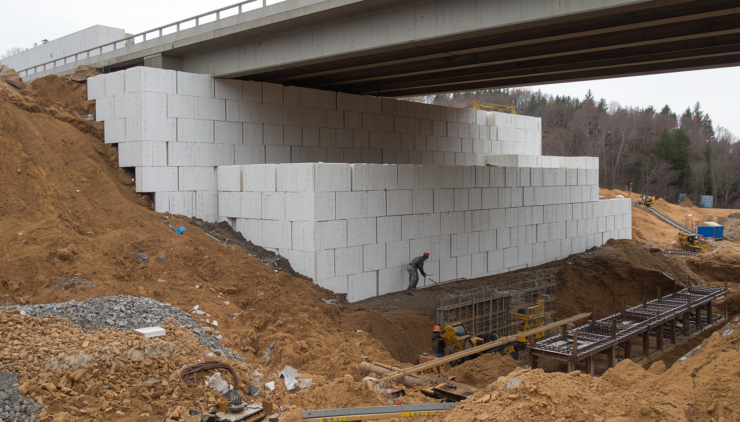
Molygran supplied precision-cut EPS Geofoam blocks to replace conventional backfill behind bridge abutments. The lightweight nature of EPS significantly reduced lateral pressure on the abutment walls and foundations, while its high compressive strength ensured long-term stability under traffic loads. The blocks were manufactured to exact project specifications, allowing for rapid installation and minimal on-site waste.
The use of Molygran’s EPS Geofoam in bridge abutment construction provided a stable, lightweight backfill solution that reduced structural loads and improved long-term performance. Installation was completed quickly and efficiently, with minimal disruption to the surrounding environment. The finished structure demonstrated excellent stability, reduced settlement, and enhanced durability under heavy traffic conditions.